

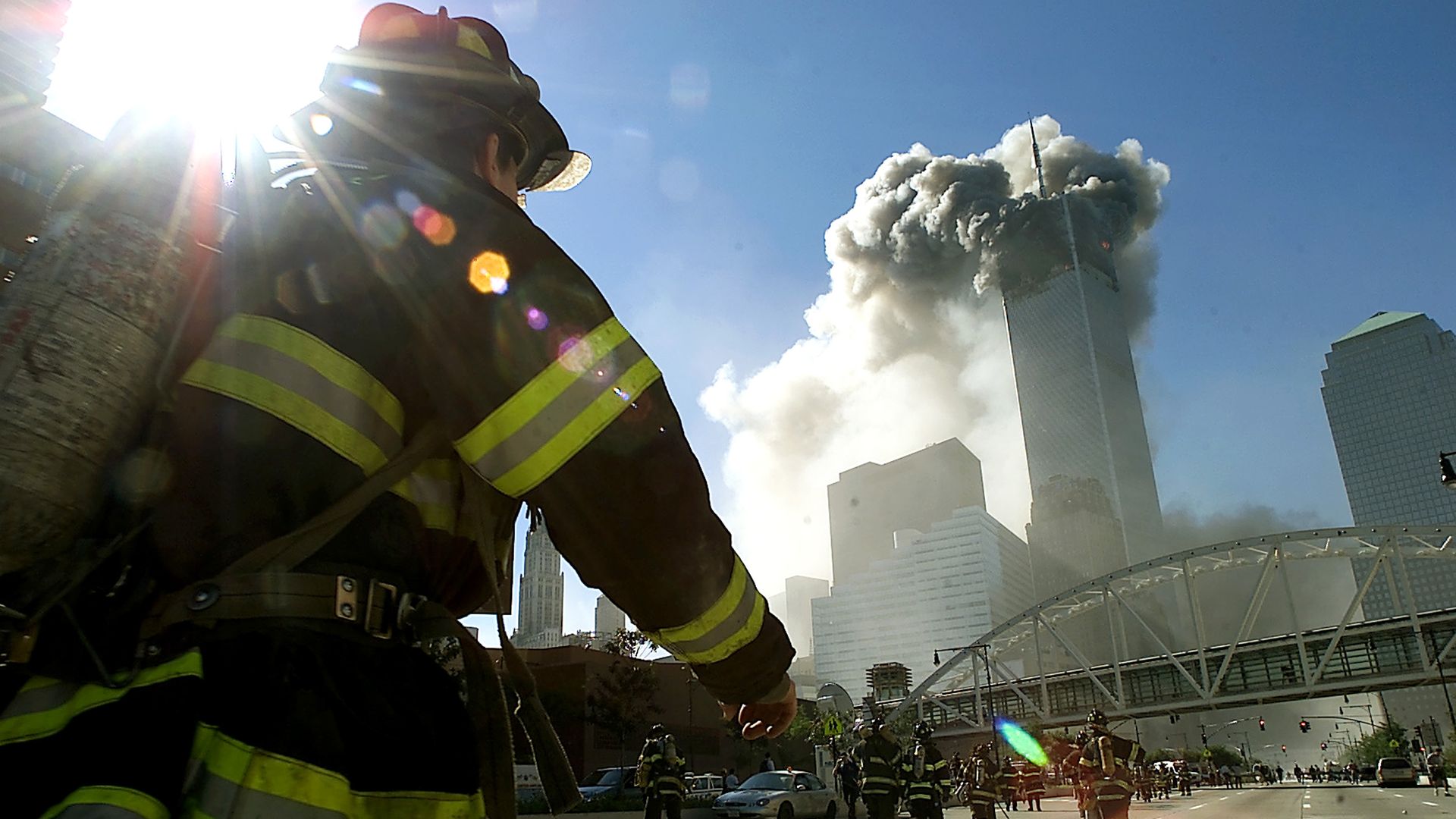
Firefighters walking toward one of the towers of World Trade Center in New York City on Sept. 11, 2001. Photo: Jose Jimenez/Primera Hora
September 11, 2001. Lower Manhattan. A 63-year-old fire chief stood in the Marriott Hotel lobby, studying the towers above him with an expression his colleagues would later describe as grave recognition. Ray Downey—the most decorated firefighter in FDNY history, the man who'd rebuilt entire cities after disasters, the architect of America's modern rescue system—knew what was coming.
He'd studied building collapses for four decades. He'd crawled through the rubble of Oklahoma City. He'd warned about the towers' vulnerability after the 1993 bombing. And now, watching the fire behavior and structural stress above him, his expertise told him a terrible truth: these buildings were going to come down.
The radio transmissions he sent that morning—urgent warnings about structural failure, attempts to evacuate firefighters from the danger zone—would be among his last acts of leadership. Because Ray Downey didn't leave. He stayed to coordinate rescue operations, to use every second of his knowledge to save as many lives as possible.
This is the story of the man the fire service calls the "Godfather of Technical Rescue"—not just how he died, but how he lived, what he built, and why his legacy continues to save lives more than two decades after his sacrifice.
Who Was Ray Downey? The Most Decorated Firefighter in FDNY History
Raymond Matthew Downey Jr. didn't just wear the uniform. Over 39 years, he redefined what it meant to be a firefighter in America. When the final count was tallied—five individual medals for valor, sixteen unit citations, and recognition from Congress to the Daily News—Ray Downey held a distinction no one in the FDNY's 150-year history had matched: most decorated firefighter, period.
But here's what those numbers don't capture: the hundreds of people he pulled from collapsed buildings, the thousands of firefighters he trained who went on to save countless others, the disaster response framework he created that became the national standard. Ray Downey transformed American emergency services from reactive chaos into systematic rescue science.
Born in Woodside, Queens on September 19, 1937, Downey joined the FDNY on April 7, 1962, after serving in the Marine Corps. He rose through every rank—firefighter, lieutenant, captain, battalion chief, deputy chief—not through politics but through an unmatched combination of operational courage and intellectual innovation. By 1995, as Chief of Special Operations Command, he commanded the FDNY's most elite rescue resources. By 2001, he was considered the nation's foremost authority on technical rescue operations.
And then September 11th took him from us, along with 342 other FDNY members. The posthumous promotion to Deputy Chief that followed was fitting, but insufficient. You can't properly honor someone who rewrote the rulebook.
Early Life and Path to Becoming a Firefighter Legend
Queens in the 1940s and 50s was tight-knit, working-class, the kind of neighborhood where everyone knew the local firefighters by name. Ray Downey grew up in this world, watching the red trucks roll past, hearing the stories at family gatherings. But unlike kids who simply admired firefighters from a distance, Downey studied them. Even as a teenager, he asked questions: How did they decide which building techniques to use? What happened when standard procedures didn't work?
The Marine Corps came first—a decision that would shape everything that followed. Military discipline, tactical thinking, the ability to stay calm when everything's going sideways: these weren't just useful traits for a firefighter. They were essential for someone who would eventually command operations at the worst disasters America had ever seen.
When Downey joined the FDNY in 1962, at age 24, his fellow probies noticed something different about him. While others focused on mastering the basics, Downey was already thinking several steps ahead. During building construction training, he'd sketch collapse patterns in his notebook. During equipment drills, he'd ask instructors about theoretical scenarios they'd never considered.
His first company assignment was typical—a busy engine company where you learned the job by doing it, night after night. But Downey's trajectory was anything but typical. Within seven years, he'd transferred to Rescue 2 in Brooklyn, beginning a specialization in technical rescue that would define the rest of his career.
Rise Through the Ranks: From Firefighter to Deputy Chief
The transfer to Rescue 2 in 1969 was the turning point. Rescue companies handle the city's worst calls—building collapses, confined space emergencies, incidents so complex that regular engine and ladder companies need specialized support. For most firefighters, rescue work is brutally demanding. For Ray Downey, it was a calling.
At Rescue 2, he didn't just respond to emergencies; he dissected them. After every major incident, he'd fill notebooks with observations: what worked, what didn't, what could be improved. When a building collapse killed civilians because rescuers lacked proper shoring techniques, Downey taught himself structural engineering principles. When a confined space rescue failed due to inadequate equipment, he researched industrial rescue methods and adapted them for fire service use.
The promotions followed his growing expertise. Lieutenant in 1972—his first formal leadership role, where he could start implementing his ideas with a crew. Captain of Squad 1 Brooklyn in 1977, commanding a newly established unit that combined firefighting with technical rescue. Squad 1 became Downey's laboratory, a place where he could develop and test the innovative approaches forming in his mind.
But the most significant assignment came in 1980 when he returned to Rescue 2 as its commanding officer. Now he had the authority and experience to truly transform how technical rescue operations were conducted. Under his leadership, Rescue 2 didn't just respond to emergencies—it pioneered solutions that other departments would later adopt nationwide.
By 1995, when Downey became Chief of Special Operations Command, he oversaw all of FDNY's rescue companies, squad companies, and hazmat units. It was the operational apex of the department, commanding the most highly trained and specialized firefighters in the city. For Ray Downey, it was the platform he needed to implement changes on a systemic scale.
The posthumous promotion to Deputy Chief in 2001, following his death on September 11th, recognized not just his sacrifice but a career that had fundamentally elevated the profession itself.
The Most Decorated Firefighter: Recognition and Medals
Walk into any New York City firehouse and you'll see medal cases displaying the department's honors. Bronze, silver, gilt—each one represents a moment when someone went beyond what the job required, when courage met impossibility and somehow prevailed.
Ray Downey's case would need its own wall.
Five individual medals for valor. Let that sink in. In a department where earning a single Medal of Valor requires acts of heroism that most people can't even imagine, Downey earned five. These aren't participation trophies or administrative recognition. These are awards given only when a firefighter faces imminent death to save someone else's life.
Add sixteen unit citations—recognition for exceptional team performance during major operations. Add the Susan Wagner Medal, awarded for the 1985 "Baby Michael" rescue where Downey entered a smoke-filled building without breathing apparatus to save a trapped invalid. Add the Thomas F. Dougherty Medal for the 1987 industrial collapse rescue where his technical expertise and leadership saved a worker buried under tons of debris.
Then there's the Administrative Medal from 1995, recognizing contributions that went beyond individual heroics to systemic improvements in fire service operations. Two separate Daily News "Hero of the Month" awards brought public recognition to match the department's internal honors.
But here's what makes Downey's decorations unique: they span his entire career. This wasn't someone who had one spectacular moment of heroism. This was consistent, repeated excellence over nearly four decades. The medals tell a story of someone who stayed committed to the highest standards of courage and professionalism from his first day to his last.
In FDNY's 150-plus years of history, thousands of firefighters have served with distinction. Hundreds have earned multiple medals. But no one—not one person—accumulated the combination of individual valor recognition, unit citations, and specialized honors that Ray Downey received. Most decorated firefighter in FDNY history isn't a marketing claim. It's a documented fact.
Ray Downey's Revolutionary Impact on Rescue Operations
Some firefighters master the job. A rare few change it entirely.
Ray Downey's influence on modern rescue operations extends so far beyond the FDNY that firefighters in California, Texas, and Florida use his protocols without necessarily knowing his name. FEMA's disaster response framework incorporates his organizational structures. International rescue teams from Germany to Japan have studied and adapted his methods.
This section isn't about hero worship—it's about innovation that actually mattered. Downey didn't just talk about improving the fire service; he built systematic solutions to problems that had plagued rescue operations for generations. He studied historical rescue operations from the London Fire Brigade during World War II, extracting lessons from rubble-choked streets half a century and an ocean away. He consulted with structural engineers, learning to read buildings the way a doctor reads X-rays.
Then he took that knowledge and created something that didn't exist before: a comprehensive, teachable, replicable framework for urban disaster response. Three areas of impact stand out—USAR development, training transformation, and disaster response systems—each one fundamental enough to define a career. Downey accomplished all three.
Pioneering Urban Search and Rescue (USAR) Development
Before Ray Downey, when a building collapsed in America, the response was organized chaos. Local fire departments did their best with whatever equipment and knowledge they had. Some had trained extensively for collapse rescue. Others winged it. No standardization, no shared protocols, no systematic approach that could be deployed anywhere in the country.
Downey looked at this problem and asked a deceptively simple question: What if we created a rescue system that could work anywhere?
The answer became Urban Search and Rescue—USAR—a comprehensive framework that transformed disaster response from improvisation into science. But developing that framework required solving multiple complex problems simultaneously.
First problem: How do you organize a rescue response when every disaster is different? Downey's solution was the task force concept—a self-sufficient unit with standardized composition. Sixty-two personnel including structural specialists, rescue technicians, hazmat experts, medical teams, and logistics support. Two complete equipment caches containing everything from concrete breakers to sophisticated listening devices. Command structure that could integrate with local authorities while maintaining operational effectiveness.
Second problem: How do you make rescue methods trainable and replicable? Downey developed systematic approaches to victim location—not guesswork, but methodical processes using visual assessment of collapse patterns, acoustic listening devices, canine search teams, and structural engineering analysis. He created void search techniques that taught firefighters to identify and safely access the spaces where trapped victims might survive. He established shoring protocols that balanced victim accessibility with rescuer safety.
Third problem: How do you get federal adoption of a new system? Here, Downey's operational track record proved crucial. When Hurricane Hugo devastated the Caribbean and Carolinas in 1989, Downey deployed with an early version of his task force concept. The effectiveness was undeniable. Hurricane Andrew in 1992 provided another proving ground. Each deployment refined the system, demonstrated its value, and built credibility.
FEMA took notice. By the mid-1990s, Downey's framework became the national standard. Today, twenty-eight FEMA USAR task forces exist across the United States, from California Task Force 3 to Massachusetts Task Force 1, all organized according to the structure Downey pioneered. When earthquakes hit, when hurricanes strike, when buildings collapse anywhere in America, the response follows Downey's playbook.
New York Task Force 1, which Downey commanded, became the prototype. Its deployments under his leadership—Hurricane Fran in North Carolina, Hurricane Marilyn in the Virgin Islands, Hurricane Opal in Florida—proved the system worked in diverse disaster scenarios. Each mission saved lives. Each mission validated the framework. Each mission trained more firefighters in techniques that would later spread nationwide.
The impact measurement is stark: Before USAR, disaster response effectiveness varied wildly based on local capabilities. After USAR, any community in America could access world-class rescue expertise within hours. The system Downey built has saved thousands of lives and continues operating exactly as he designed it.
Transforming Technical Rescue Training and Standards
Having brilliant operational ideas means nothing if you can't transfer that knowledge to the next generation. Ray Downey understood this completely. In 1995, he founded the Technical Rescue School, the first comprehensive collapse rescue training facility of its kind.
Before this school existed, technical rescue training in the fire service was inconsistent at best, nonexistent at worst. Firefighters learned through trial and error, through hard-won experience at actual emergencies, sometimes through tragic mistakes that cost lives. Downey looked at this situation and saw an entirely preventable problem.
The Technical Rescue School changed everything. Located at the FDNY Special Operations Command, it offered standardized curriculum covering every aspect of collapse operations. But Downey didn't create another boring lecture series. He built a comprehensive training system combining classroom instruction on building construction and collapse patterns with hands-on practical exercises in controlled environments, then scenario-based drills that simulated real emergency conditions.
The curriculum covered subjects most fire academies never touched: advanced shoring techniques, sophisticated void search methods, structural engineering principles, hazmat considerations in collapse environments, confined space rescue integration. Downey authored rescue manuals and operational bulletins that became required reading throughout the fire service. These weren't theoretical documents—they were practical guides drawn directly from his operational experience.
What made the training revolutionary was its systematic approach. Instead of teaching individual skills in isolation, Downey created a framework showing how everything connected. A student didn't just learn how to build a shore—they learned why that particular shoring technique worked for specific collapse patterns, how to assess when shoring was necessary versus when other approaches made more sense, what to do when standard procedures didn't apply.
The impact rippled outward. Firefighters trained by Downey returned to their home departments and shared these methods. Fire academies nationwide began incorporating his curriculum. State training systems adopted his protocols. Today, twenty years after his death, recruit firefighters learn rescue techniques that trace directly back to Downey's teaching, often without realizing they're following methods he pioneered.
The effectiveness shows in rescue outcomes. Departments using Downey's training protocols consistently achieved better results—faster victim location, safer rescue operations, reduced responder injuries. The training didn't just improve individual firefighters; it elevated the entire profession's technical capability.
Innovation in Disaster Response Systems
Ray Downey wasn't satisfied with just operational excellence. He wanted systematic improvements that would protect firefighters and civilians for decades after he retired.
His approach to innovation was methodical. While other chiefs relied solely on current experience, Downey studied history. He obtained World War II-era documents from the London Fire Brigade describing collapse rescue operations during the Blitz. He analyzed what worked when London firefighters pulled people from bombed-out buildings, and he adapted those historical lessons for modern contexts.
One major innovation: co-developing the FDNY's Collapse Rescue Bulletin, a comprehensive guide distributed throughout the department. This wasn't just another policy document. It was an operational manual drawn from real incidents, explaining how to assess collapse patterns, where to find void spaces, which shoring techniques worked for different structural failures. Firefighters carried these bulletins on their rigs, consulting them during actual emergencies.
Downey also pushed for advances in firefighter protective equipment. Working with manufacturers, he helped develop improved bunker gear technology with better thermal protection and enhanced mobility for technical rescue operations. The specifications he established became industry standards adopted by fire departments nationwide.
Perhaps his most innovative—and compassionate—contribution was the "Family Transport Vans" initiative. Downey recognized that when firefighters deployed to distant disasters for days or weeks, their families back home worried constantly. He established a system where FDNY would provide transportation for firefighters' families if they needed to travel during the deployment—whether for emergencies back home or to visit their deployed loved ones. It was a small program that acknowledged a simple truth: firefighters perform better when they know their families are supported.
Other innovations included communication systems improvements for disaster scenes, incident command structure refinements that clarified authority and responsibility, equipment standardization across rescue companies so any firefighter could operate any tool, and inter-agency coordination protocols that reduced the friction between different responding organizations.
Each innovation addressed a real problem Downey had observed. Each was tested in actual operations before being widely implemented. And each spread beyond the FDNY as other departments recognized their value.
The cumulative impact: American fire service in 2001 was fundamentally more capable, more professional, and more systematic than it had been in 1962 when Downey started. Not all of that improvement came from one person, obviously. But Ray Downey's contributions were disproportionate, foundational, and enduring.
Leadership During America's Darkest Hours
Some chiefs spend entire careers without facing a truly catastrophic incident. Ray Downey commanded operations at three of America's worst domestic disasters—and his performance during each one became the standard for crisis leadership in the fire service.
The progression was almost cruelly sequential. The 1993 World Trade Center bombing introduced him to terrorism response at the towers that would later claim his life. Oklahoma City in 1995 showed what domestic terrorism could accomplish and tested his USAR framework on the national stage. And then September 11, 2001, brought everything full circle in the most devastating way possible.
Each disaster built on previous experience. Each response demonstrated why Downey had become the person everyone turned to when situations exceeded normal operational capacity. His calm under extreme pressure, his ability to organize complex multi-agency responses, his technical expertise in assessing structural dangers—these qualities weren't theoretical. They were proven repeatedly when everything was falling apart.
The 1993 World Trade Center Bombing Response
February 26, 1993. 12:17 PM. A massive truck bomb detonated in the underground parking garage beneath the North Tower of the World Trade Center. The explosion killed six people immediately, injured over a thousand, and created a crisis unlike anything New York had faced.
Ray Downey, then Captain of Rescue 2, became the Rescue Operations Officer for the incident—responsible for coordinating all technical rescue operations in a building filled with smoke, damaged infrastructure, and tens of thousands of trapped occupants.
The challenges were unprecedented. Smoke from the explosion infiltrated throughout the towers via elevator shafts and stairwells. Power was knocked out, leaving the buildings in darkness. Communication systems failed. And nobody knew initially whether this was a single event or the first of multiple attacks.
Downey's approach was methodical. First priority: establish command and control. Second: systematic search of affected areas. Third: structural assessment to identify collapse risks. Fourth: coordination with FBI, ATF, and NYPD as the investigation unfolded alongside rescue operations.
The operation lasted days, not hours. Rescue teams searched floor by floor through 110-story buildings using emergency lighting and portable equipment. Structural engineers evaluated damage while operations continued. Medical teams established aid stations. And Downey coordinated it all, maintaining operational effectiveness despite chaos that would overwhelm less experienced commanders.
Here's what haunts in retrospect: Downey immediately recognized the towers' vulnerability. After the bombing, he warned that the World Trade Center remained a terrorist target, that the 1993 attack was reconnaissance for something worse. He pushed for enhanced security, improved evacuation procedures, better structural reinforcement. He was ignored by the people who made those decisions.
Eight years later, his worst predictions came true.
Oklahoma City Federal Building Bombing (April 19, 1995)
The call came early morning on April 19, 1995. Timothy McVeigh had detonated a truck bomb outside the Alfred P. Murrah Federal Building in Oklahoma City, collapsing half the nine-story structure and killing 168 people, including 19 children from the building's daycare center.
Within twelve hours, Ray Downey was on the ground as FEMA's Chief of Operations for the rescue and recovery effort.
What he found was worse than any collapse he'd seen. The blast had created a progressive structural failure, leaving half the building standing but catastrophically unstable. Victims—including those children—remained buried in the rubble. And every minute rescuers spent in the debris pile risked secondary collapse that could kill them too.
Downey led a sixteen-day operation that required balancing impossible competing demands: speed (because trapped victims might still be alive) versus caution (because the structure could fail at any moment). He coordinated multiple USAR task forces, integrated local fire and police departments, managed relationships with federal investigators who needed to preserve evidence while rescuers needed to save lives.
The technical challenges tested everything he'd developed. Unstable debris required constant structural assessment and shoring. Void spaces had to be searched systematically despite limited access. Weather—including a severe storm mid-operation—threatened both rescuers and structural stability. The emotional toll of recovering children's bodies affected hardened firefighters who'd seen everything.
Through it all, Downey maintained operational discipline and tactical effectiveness. His command presence—calm, analytical, decisive—kept hundreds of responders focused despite circumstances that pushed everyone to emotional limits.
Governor Frank Keating later said Downey's leadership saved countless lives and gave Oklahoma City hope when everything seemed hopeless. The governor gave Downey a rosary blessed by Pope John Paul II, which Downey carried in his pocket for the rest of his life. It was found with his remains after September 11th.
Oklahoma City solidified Downey's reputation as the nation's foremost disaster response expert. When the next major incident occurred, everyone knew who to call.
September 11, 2001: The Ultimate Sacrifice
The morning of September 11, 2001, started like thousands of others for Chief Ray Downey. At 63, he should have been thinking about retirement, about spending more time with his family, about a life beyond the constant demands of Special Operations Command.
Instead, when the first plane hit the North Tower at 8:46 AM, Downey responded immediately to the World Trade Center—a building complex he knew better than almost anyone alive after the 1993 bombing.
He reported directly to Chief of Department Pete Ganci, establishing a command post near the towers. As the senior technical expert on scene, Downey's role was critical: assess structural integrity, coordinate rescue operations, advise on life safety decisions.
What happened next has been reconstructed through witness accounts and radio transmissions. Downey evaluated the fire behavior—the intense heat, the way the buildings were responding to the damage, the structural stress visible to someone who'd spent forty years studying collapse patterns.
And he recognized what was coming.
Multiple sources report that Downey anticipated the towers' collapse. His expertise—studying building failures, commanding operations at major structural collapses, understanding how fire affects steel-frame buildings—told him these structures couldn't sustain what they were experiencing.
He transmitted warnings. Attempted to get firefighters out. But hundreds of firefighters were already inside, climbing stairs, searching for victims, doing what firefighters do. The evacuation orders competed with the operational imperative to rescue thousands of civilians still trapped above the impact zones.
Downey was last seen in the Marriott Hotel lobby between the two towers, directing operations, still trying to coordinate rescue efforts even as he recognized the magnitude of the danger.
The South Tower collapsed at 9:59 AM. The North Tower followed at 10:28 AM. The Marriott—where Downey had been positioned—was crushed between them.
Ray Downey died in the line of duty at age 63, along with Chief Pete Ganci, Chief of Department, and 341 other FDNY members—the worst single-day loss in fire service history.
His body was recovered weeks later from the debris. His rosary from Oklahoma City Governor Keating was still in his pocket. He was posthumously promoted to Deputy Chief in recognition of his service and sacrifice.
The tragic irony is inescapable: The person most qualified to recognize the danger, most capable of coordinating the response, most experienced in disaster operations—he was also the person who understood that leaving wasn't an option. Not when there were still lives to save. Not when his expertise might make the difference.
That's who Ray Downey was. Even when he knew the odds, even when his own survival was at stake, the mission came first.
Frequently Asked Questions About Ray Downey
Was Ray Downey really the most decorated firefighter in FDNY history?
Yes. This isn't marketing hyperbole—it's documented fact. Ray Downey received five individual medals for valor, a distinction almost unprecedented in FDNY's 150-year history. Add sixteen unit citations, the Susan Wagner Medal, the Thomas F. Dougherty Medal, the Administrative Medal, and two Daily News Hero of the Month awards, and you have a record of recognition that no other firefighter in department history has matched.
To understand why this matters, you need to understand FDNY's medal hierarchy. A Medal of Valor isn't given for doing your job well. It's awarded only when a firefighter faces imminent mortal danger to save someone else's life. One such medal represents an extraordinary moment of courage. Five represents a career-long pattern of choosing heroism when easier options existed.
Unit citations recognize exceptional team performance during major operations—the kind of incidents that require coordinated excellence from an entire company or command. Sixteen such citations across a career means Downey repeatedly led teams through the city's worst emergencies with distinction that merited formal recognition.
The comparison isn't close. The FDNY has employed thousands of firefighters over its history, many of them extraordinarily brave and skilled. But the combination of individual valor, team leadership, and systematic contributions that earned Downey's accumulated honors remains unmatched.
What exactly is USAR and how did Ray Downey create it?
Urban Search and Rescue (USAR) is a comprehensive disaster response system for building collapses, earthquakes, hurricanes, terrorist attacks, and other catastrophic incidents requiring specialized rescue capabilities. Before Ray Downey developed the USAR framework, America had no standardized national approach to these disasters.
Think about that for a moment. When a major building collapsed pre-USAR, the response depended entirely on local capabilities. Some cities had trained collapse rescue teams. Others improvised with whatever resources they had. No shared protocols, no equipment standards, no systematic training program that worked everywhere.
Downey changed this by developing a complete framework that addressed every aspect of disaster response. He created the task force concept: self-sufficient units of sixty-two personnel including rescue specialists, structural engineers, hazmat teams, medical support, and logistics staff. He established equipment standards ensuring every task force had the tools needed for any scenario. He developed training protocols that could be taught consistently across the country.
The innovation process wasn't theoretical. Downey studied historical collapse operations from World War II London Fire Brigade documents. He applied lessons from his own operational experience at countless New York incidents. He consulted with structural engineers, learning to understand building behavior at a technical level most firefighters never reach. Then he tested everything in real deployments—Hurricane Hugo, Hurricane Andrew, other disasters—refining the system based on actual results.
FEMA adopted Downey's framework as the national standard by the mid-1990s. Today, twenty-eight FEMA USAR task forces exist nationwide, organized exactly as Downey designed. When disasters strike anywhere in America, the response follows his protocols. The system he built has saved thousands of lives and continues operating precisely as intended.
Did Ray Downey predict the World Trade Center collapse on 9/11?
According to multiple witness accounts and documented radio transmissions, Ray Downey recognized the towers' structural danger and attempted to warn others before the collapse occurred. But we need to be careful about the word "predict."
Downey didn't have supernatural foresight. What he had was forty years of expertise studying how buildings fail, particularly how fire affects structural integrity. He'd commanded operations at the 1993 World Trade Center bombing. He'd studied the towers' construction. He'd seen how fire-weakened steel behaves under load at countless incidents throughout his career.
When he assessed the situation on September 11—observing the fire intensity, the structural damage from the plane impacts, the visible stress on the buildings—his technical knowledge led him to a professional conclusion: these structures were in danger of catastrophic failure.
He transmitted warnings. The content and timing of these warnings have been documented through radio logs and witness statements. He attempted to initiate evacuation procedures. But hundreds of firefighters were already committed to operations inside the towers, and the evacuation orders competed with the urgent need to rescue civilians trapped above the impact zones.
The tragic reality is that Downey's expertise allowed him to recognize a danger that many others didn't see until it was too late. Other structural experts who studied the collapse afterward confirmed that someone with Downey's knowledge would have recognized the warning signs visible that morning.
But here's the crucial point: recognizing the danger didn't mean leaving. Downey stayed in the command position, continued directing operations, kept trying to save lives even knowing the risk. That's not prediction—it's professional commitment taken to its logical, terrible end.
What disasters did Ray Downey respond to during his career?
Over thirty-nine years, Ray Downey responded to hundreds of major incidents, but certain deployments stand out for their scale and significance:
The 1993 World Trade Center bombing established him as a terrorism response expert. As Rescue Operations Officer, he coordinated the multi-day rescue and investigation operation in both towers, dealing with unprecedented smoke infiltration and structural assessment challenges.
Hurricane Hugo in 1989 devastated the Caribbean and Carolinas with Category 5 winds. Downey deployed with early USAR resources, conducting search and rescue operations in catastrophic wind damage that had flattened entire communities.
Hurricane Andrew in 1992 hit Florida and Louisiana as one of the most destructive hurricanes in U.S. history. Downey commanded USAR operations searching through the wreckage of homes, businesses, and infrastructure destroyed by 165 mph winds.
The Oklahoma City bombing on April 19, 1995 became Downey's most significant pre-9/11 deployment. As FEMA's Chief of Operations, he led the sixteen-day rescue and recovery operation at the Alfred P. Murrah Federal Building, coordinating multiple task forces in an incredibly dangerous structural environment.
Hurricane Fran in 1996 required USAR deployment to North Carolina for flood rescue operations and structural collapse responses in the storm's aftermath.
Hurricane Marilyn in 1995 devastated the U.S. Virgin Islands, where Downey deployed for rescue and recovery operations on islands completely cut off from normal support.
Hurricane Opal in 1995 hit the Florida panhandle, requiring additional USAR response before Downey had fully recovered from previous deployments.
And then September 11, 2001—the incident that took his life while he was attempting to command the largest rescue operation in American history.
Beyond these major deployments, Downey responded to countless local New York incidents: building collapses, industrial accidents, confined space emergencies, vehicle extrications, and hazmat situations. Each incident added to his operational experience, informing the systematic improvements he developed over his career.
How is Ray Downey remembered in the fire service today?
The Ray Downey Courage and Valor Award, established by Fire Engineering magazine and the Fire Department Instructors Conference, is presented annually to firefighters who demonstrate exceptional heroism. It's considered one of the fire service's most prestigious honors, and receiving it means your peers recognize something extraordinary about your service.
The Deputy Chief Raymond Downey All Hazards Training Site at the FDNY Academy on Randall's Island trains thousands of firefighters every year in the technical rescue methods Downey pioneered. Every recruit firefighter who passes through that facility learns protocols he developed, often without knowing they're following his playbook.
The Congressional Fire Services Institute's Mason Lankford Award was presented posthumously to Downey in 2002, recognizing his national impact on emergency services and fire service leadership.
But the most meaningful memorial isn't a building or an award. It's operational. Right now, somewhere in America, firefighters are using void search techniques Downey developed to locate trapped victims. A USAR task force is deploying to a disaster following organizational structures he created. An instructor is teaching collapse rescue methods he systematized. His son Joe commands the Rescue Battalion, continuing the mission. His son Chuck oversees Fire Academy training, ensuring new firefighters learn the right way from day one.
Walk into any firehouse and mention Ray Downey's name. The older firefighters will have stories—working with him, training under him, seeing him at major incidents. The younger ones might not know the name, but they're using his methods every shift without realizing it.
That's legacy. Not bronze plaques and memorial ceremonies (though those exist too). But living influence that continues saving lives two decades after his death. The protocols work. The training holds up. The framework he built remains the national standard.
Twenty-eight FEMA USAR task forces still organize exactly as Downey designed. Fire academies across America still teach his curriculum. The Godfather of Technical Rescue isn't just remembered—he's present in every major rescue operation conducted in this country.
And every September 11th, when the fire service remembers its 343 lost from that day, Ray Downey represents something beyond individual sacrifice. He represents what firefighters aspire to: technical mastery combined with operational courage, innovation serving the mission, and commitment maintained even when the cost is everything.


